The Flat Text Problem in Bantu Languages
Why Current AI Cannot Truly Support Bantu Languages — and How BantuNomics Can Help
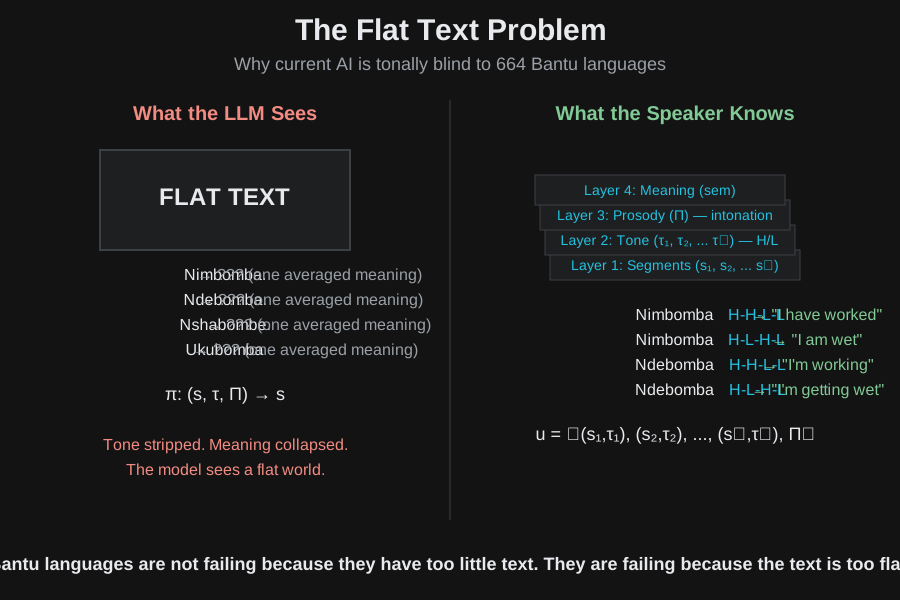
The flat text problem is the structural failure that occurs when AI systems are trained on ordinary orthographic text for Bantu languages, even though the writing system omits tone, vowel length, and prosodic information that carry meaning in speech. The model sees only a flattened surface string, while native speakers process a richer linguistic object made of segments, syllables, tone, timing, and discourse prosody. This causes the model to collapse spoken distinctions that are obvious to native speakers into a single token sequence. This paper defines the problem, demonstrates it with Bemba examples, and argues that the flat text problem — not data scarcity — is the primary barrier to high-quality Bantu language AI.
1. The Core Problem
Today's AI systems treat most African languages as if they were slightly exotic versions of English: flat sequences of letters with no tone or prosody. For Bantu languages, this assumption is false.
Tone and syllable structure are not cosmetic details; they are part of the grammar and lexicon. Ignoring them means your models systematically mis-parse meaning for hundreds of millions of speakers.
For many Bantu languages, standard orthography does not obligatorily mark tone with accents, and often does not systematically encode length either, even where those features are contrastive. As a result, text that looks complete to an English-shaped NLP pipeline is actually an under-specified projection of the real language.
Bantu languages are not low-resource versions of English; they are under-represented tonal systems whose standard orthographies hide meaning from current AI pipelines.
2. What "Flat" Means — The Flat Earth Analogy
A useful analogy: current LLMs behave as if they believe in a flat earth. They infer over a two-dimensional representation because the third dimension — tone — has been removed from the map.
Flat text hides at least four kinds of information:
- Lexical contrasts: the same segmental form may correspond to different words depending on tone
- Grammatical contrasts: tense, aspect, mood, negation, and clause type may be signaled by tone patterns on the verb
- Syllable structure and weight: tone associates to tone-bearing units (syllables or moras), and weight conditions tone placement
- Prosodic interpretation: phrase-level patterns, focus, and question intonation change interpretation beyond the segmental string
When these dimensions are not represented, the model does not merely lose detail — it loses access to part of the language's meaning system.
3. Bemba as a Concrete Example
In Bemba (Icibemba), the flat text problem manifests as segmentally identical forms that encode entirely different meanings depending on tone. From the BantuNomics corpus:
Infinitive pair
Flat text: both begin with Ukubomba. In speech, speakers distinguish "work" from "get wet" by tone on the root. The writing doesn't show this.
Perfect tense — 1st person singular
Progressive — 1st person singular
Future negative — 1st person singular
For a Bemba speaker, these contrasts are automatic. For an AI system trained only on flat strings, all four pairs collapse: Nimbomba, Ndebomba, Nshabombe each become a single type. The tonal distinctions that separate "work" from "get wet" are invisible.
The same structural pattern occurs across the entire Bantu family — not just Bemba, but Zulu, Shona, Sesotho, Kinyarwanda, Swahili, and hundreds more.
4. Why This Matters for LLMs, ASR, and TTS
LLMs trained on flat orthography are forced to learn from strings that merge distinct spoken forms into a single written representation. Their internal representations are systematically ambiguous in ways invisible to the model, the benchmark, and often the engineer.
Generates text that looks correct while missing meaning — because the tonal distinction never survives transcription. A system can output "Nimbomba" and have no way to indicate whether the speaker said "I have worked" or "I am wet."
Produces intelligible but unnatural speech — because pitch is treated as post-processing rather than linguistic structure. The system says "Ukubomba" with the wrong melody, changing which verb Bemba speakers hear.
Confidently average over incompatible meanings because the orthography conceals the distinction. Assistants and translation tools silently misinterpret user intent in exactly the short utterances that are most common on mobile.
5. Why Current AI Does Not Know It Is Failing
The problem is not only that tone is missing — it is that the system is not designed to notice that it is missing. Tokenization, pretraining objectives, and evaluation sets are generally defined over flat text, so the model receives no explicit signal that another meaning-bearing dimension exists.
Most NLP evaluation for African languages is still dominated by flat orthography, translation pairs, and token-level metrics. Systems can appear strong while failing on tonal minimal pairs, tone-conditioned morphology, and prosodic contrasts that native speakers hear instantly. This is why teams often conclude they need "more data" when the deeper problem is that the representation itself is wrong.
This is not a data-scarcity bug. It is a representation bug. You cannot solve Bantu language AI by adding more flat text to an English-shaped system.
6. Why a Syllable-Aware Approach Is the Minimum Fix
The first step is to restore the language's real units of organization: valid syllable inventories, tone-bearing units, and the tonal patterns speakers actually use.
Before you can fix tone, you need to respect the basic building blocks: CV, NCV, CGV patterns — not just letters. How syllable weight interacts with tone. How primary-school syllable charts already encode this knowledge as the community-approved discrete units children learn to read.
Understanding and encoding the language's syllable set is the minimum step to design better tokenization, model tone on the right units (syllables and moras rather than arbitrary byte-pairs), and align AI systems with existing literacy practices.
7. How BantuNomics Solves This
BantuNomics addresses the flat text problem by treating tone as a first-class linguistic signal and rebuilding the missing layer between orthography and meaning.
- Syllable inventories: 140+ valid syllables per language, grounded in native-speaker literacy and acoustic measurement
- Tone-aware corpora: every morphological record carries mora-level H/L tone assignments with rule provenance
- Tonal minimal pairs: evaluation sets that expose hidden failure modes — identical written forms with different tonal meanings
- Acoustic validation: 48kHz speaker recordings that prove tonal predictions against physical measurements
- Speaker calibration: per-speaker F₀ baselines transform textbook estimates into measured constants
The key message for frontier AI companies: Bantu languages are not failing because they have too little text. They are failing because the text they use is too flat.
8. The Opportunity
Fixing the flat-text problem is not just a fairness initiative — it is a product unlock for search, assistants, voice, education, financial services, and communication tools across large African-language user bases. Companies that solve this early will not just support more languages by name; they will build systems that native speakers actually trust.
The people who rely most on local languages — rural communities, older speakers, early readers — experience the worst performance today. You leave on the table a huge user base simply because the models don't actually speak their language.
9. Recommended Next Step
Launch a joint pilot with BantuNomics on 1–3 tonal Bantu languages using three workstreams:
- Representation design: tone-aware tokenization and phonological layers
- Corpus creation: tone-aware training data and tonal minimal-pair evaluation sets
- Model adaptation: ASR, TTS, and LLM fine-tuning with tone as explicit signal
The goal: measurable gains on native-speaker judgments, tonal minimal pairs, and prosodic naturalness — not just conventional text metrics.
@techreport{cintu2026flattext,
  title     = {The Flat Text Problem in Bantu Languages},
  author    = {Cintu, Conti and others},
  year      = {2026},
  institution = {3MegaLabs},
  url       = {https://bantunomics.com/research/flat-text-problem}
}